
1. The Phase 1: Digital Used Car Research
Your used car research must begin weeks before you step onto a dealership lot. The biggest mistake buyers make is 'falling in love' with a car they see in person before doing the math. You must perform a ruthless used car comparison between at least three different makes and models that fit your criteria.
Research the specific engine codes and transmissions. If you are comparing a 2018 Ford Focus against a 2018 Toyota Corolla, your research will immediately uncover that the Ford's PowerShift transmission is a notorious failure point, drastically altering the true value comparison between the two vehicles.
- Filter by Generation, not just Year: A 2015 model might be the last reliable year of a proven generation, while the 2016 is the problematic first year of a redesign.
- TSB Deep Dive: Search the NHTSA database for Technical Service Bulletins specific to your target vehicle to see what the manufacturer is quietly fixing.
- Calculate TCO (Total Cost of Ownership): Compare the projected insurance rates and known maintenance schedules (e.g., when does the timing belt need replacing?).
2. The Critical Used Car Questions to Ask Sellers
Whether you are dealing with a private party or a dealership, your initial used car questions must establish the vehicle's administrative and mechanical baseline. Do not ask 'Is the car in good shape?'—that invites a subjective lie. Ask objective, verifiable questions.
Ask: 'Do you have the service records for the last 30,000 miles?' Ask: 'Has the car ever had paintwork or body panels replaced?' (This is different than asking if it was in an accident, as many accidents aren't reported). Ask: 'Can my independent mechanic put this car on a lift tomorrow morning?' If they hesitate on the last question, walk away immediately.
Dealers are trained to deflect negative questions. Force them to answer “Yes” or “No” regarding specific mechanical history and title status.
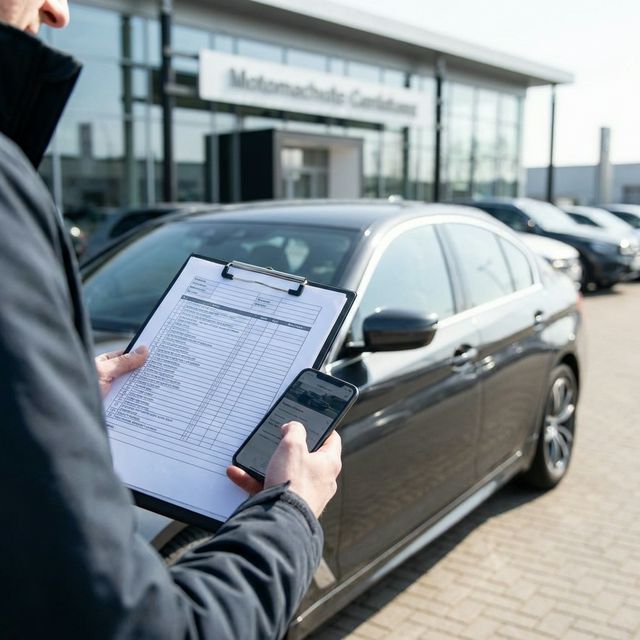
3. The Physical Used Car Checklist: The Walkaround
When you arrive to see the car, do not let the salesperson rush you into the driver's seat. Your physical used car checklist begins with a 'cold start.' Tell the seller explicitly not to warm the car up before you arrive. A warm engine hides ticking lifters, failing tensioners, and blue exhaust smoke.
Inspect the panel gaps. A misaligned hood or a door that requires extra force to close is a glaring indicator of structural repair. Check the date codes on the tires—if the tires have wildly different date codes or mismatched brands, the previous owner was likely struggling to afford basic maintenance.
4. The Test Drive: Stress-Testing the Mechanics
A five-minute loop around the dealership block is entirely insufficient. A proper test drive must include hard acceleration (to test transmission slipping), highway speeds (to test wheel bearing hum and alignment), and a section of rough road (to test suspension clunks).
Turn off the radio. Listen to the car. Does the steering wheel vibrate under hard braking? That's a sign of warped brake rotors. Does the transmission hesitate when shifting from Reverse to Drive? That indicates failing valve bodies or low fluid pressure.
5. The Autoscore Audit: Securing Your Investment
Even the most meticulous buyer with a perfect checklist cannot see inside the engine block or predict the failure timeline of an electronic control unit. This is where an Autoscore report becomes your ultimate negotiating safety net.
By combining your physical inspection with our predictive data analytics, you verify not just the car's current state, but its statistical future. If your test drive raises a slight concern about the transmission, our report will tell you exactly how common that failure is for that specific VIN, giving you the leverage to walk away or demand a massive price reduction.
| Buying Phase | Standard Buyer Actions | Autoscore Professional Approach |
|---|---|---|
| Research (Digital) | Looking at pictures & prices | Deep model-specific reliability comparison |
| Initial Contact | Asking 'Is it available?' | Asking targeted, objective mechanical questions |
| The Inspection | Kicking the tires | Cold-start mechanical checklist & OBD2 scanning |
| The Assurance | Trusting the 'Clean Carfax' | Running an Autoscore predictive failure analysis |