
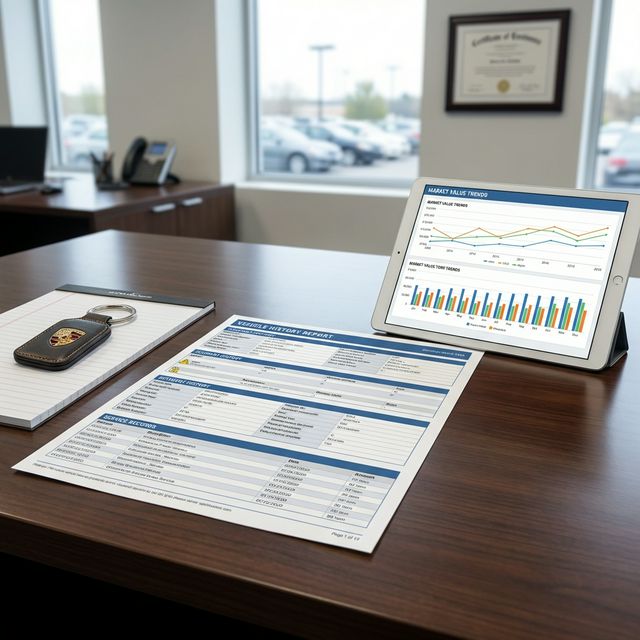
1. The Anatomy of a Professional Used Car Report
A standard used car report is a collection of public and private data points assigned to a specific Vehicle Identification Number (VIN). It aggregates information from state registries, police departments, and insurance companies to create a chronological timeline of the vehicle's life.
The most critical sections are the Title History (which flags salvage or rebuilt statuses), the Odometer History (to detect rollbacks), and the Accident History. However, professional appraisers know that the absence of a reported accident does not guarantee a clean car. According to data from the NHTSA, a significant percentage of minor collisions are never reported to insurance, meaning they will never appear on a standard used car history check.
- Title Brands: Look out for 'Flood', 'Salvage', 'Lemon Law', or 'Rebuilt' markers.
- Odometer Discrepancies: A vehicle whose mileage mysteriously drops between service intervals is an immediate red flag.
- Fleet Usage: Cars primarily used as rentals or taxis usually experience significantly higher wear and tear.
2. Decoding the Used Car History: What You Aren't Seeing
While a used car history gives you the administrative baseline, it often misses the mechanical reality. This phenomenon is known as the 'Reporting Lag.' State DMV databases can take up to six months to process a title brand change. If a car was totaled in a flood last month, it might still have a 'clean' used car report today.
Additionally, you must look at the density of ownership. A car that has had five owners in three years is a massive warning sign. It almost always indicates a persistent, unresolvable mechanical issue that forces each subsequent owner to sell the car shortly after purchasing it. This severely drags down the overall used car values for that specific listing.
A used car report is a record of what was caught, not a complete record of everything that happened. Always pair documentation with a physical inspection.
3. Precision Used Car Valuation and Market Estimates
Determining an accurate used car valuation is not as simple as looking up a single number online. The true value of a specific vehicle is highly dynamic, fluctuating based on regional demand, current interest rates, and the exact mechanical health of the engine installed.
When you calculate a used car estimate, you must start with the baseline market condition and then deduct for anticipated wear. If a comprehensive used car report shows that the timing belt has not been replaced on a 100,000-mile engine, the true value of that car is the market price minus the $1,500 cost of that imminent repair.
4. Bridging the Gap: Administrative vs. Mechanical Data
The fundamental flaw in traditional used car values is that they assume 'average condition.' But there is no such thing as an average 10-year-old car. A BMW that was scrupulously maintained by an enthusiast is worth significantly more than the exact same model that suffered through 30,000-mile oil change intervals.
To get a true used car valuation, you must combine the administrative data from the used car history with predictive mechanical analytics. Knowing that a specific generation of Audi has a 40% chance of catastrophic transmission failure between 80,000 and 100,000 miles radically alters your purchasing calculus.
5. The Autoscore Approach to Vehicle Analytics
This is where Autoscore bridges the information gap. We don't just provide a regurgitated used car report. Our system evaluates the specific vehicle's DNA—cross-referencing the VIN against thousands of documented mechanical failure patterns. We look at the exact engine code, the transmission variant, and the historical weakness of that specific manufacturing run.
By integrating advanced reliability metrics with real-time market data, our platform provides a used car estimate that reflects the car's actual roadworthiness, helping you negotiate from a position of absolute, data-backed strength.
| Feature | Basic History Check | Autoscore Analytical Report |
|---|---|---|
| Reported Accidents | Yes (if in database) | Yes + Hidden Damage Indicators |
| Odometer Rollback Detection | Basic timeline check | Advanced algorithmic flagging |
| Predictive Mechanical Failure | None | Detailed Engine & Component Analysis |
| Precision Used Car Valuation | Static 'Blue Book' numbers | Dynamic valuation based on reliability score |