
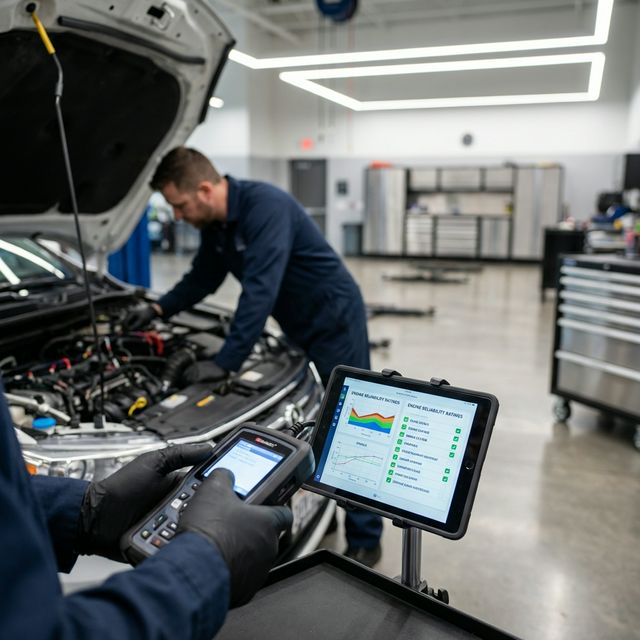
1. The Myth of Brand-Level Used Car Reliability
Most consumers shop by brand: 'I want a reliable Honda.' This is a fundamentally flawed approach to used car reliability. Automotive manufacturing is modular. A single brand might produce a phenomenal naturally aspirated 4-cylinder engine in one factory, while simultaneously producing a disastrous, oil-burning turbocharged engine in another.
To accurately gauge reliability, you must drill down to the specific generation and engine code. For example, the early Volkswagen EA888 engine (Gen 1 and 2) is notorious for timing chain tensioner failures—a $3,000 repair. Yet, the Gen 3 version of that exact same engine code is highly robust. Your research must be laser-focused on the exact year and powertrain combination.
- Generational Shifts: The first year of a new vehicle generation is statistically the most prone to 'teething issues.' Automakers use early adopters as beta testers.
- Powertrain Specifics: A Honda CR-V with a 2.4L naturally aspirated engine has a drastically different reliability profile than the same year CR-V with the 1.5L turbocharged engine.
- Transmission Types: A reliable engine mated to an early-generation CVT (Continuously Variable Transmission) or a dry-clutch automatic (like Ford's PowerShift) is a recipe for disaster.
2. Identifying the Used Car Years to Avoid
Every professional mechanic has a mental list of used car years to avoid. These are the models where the cost of routine repairs wildly exceeds the vehicle's market value. According to data analysis by Consumer Reports and industry databases, severe failure clusters usually occur when a manufacturer introduces drastic changes to meet new emissions or fuel economy standards.
Before committing to a purchase, you must cross-reference the specific year against known Technical Service Bulletins (TSBs) and NHTSA complaint registries. If a specific model year shows a massive spike in transmission replacements around the 80,000-mile mark, that year must be blacklisted from your search.
A 'good deal' on a notoriously unreliable model year is just a down payment on your mechanic's next vacation. Never buy the cheapest car of the most expensive generation.
3. The Used Car Mileage Debate: Does it Still Matter?
Historically, the 100,000-mile mark was considered the end of a vehicle's useful life. In 2026, used car mileage is a secondary metric to maintenance density. A modern engine block is often capable of 250,000 miles, but the peripheral components (alternators, water pumps, suspension bushings) operate on strict thermal and kinetic lifespans.
A car with 120,000 highway miles and a thick folder of dealership service records is almost always a safer bet than an identical car with 60,000 city miles and zero maintenance history. Heat cycles and stop-and-go traffic degrade components exponentially faster than steady-state highway cruising.
4. The Ultimate Technical Used Car Checklist
Visual inspections only catch cosmetic flaws. A professional used car checklist focuses on the expensive mechanical realities. You must look past the shiny paint and fresh tire dressing.
Key technical checkpoints include inspecting the coolant reservoir for oil contamination (the 'milkshake' effect, indicating a blown head gasket), checking the transmission fluid for a burnt smell, and using an OBD2 scanner to verify that the readiness monitors haven't been recently cleared to hide an active Check Engine Light.
5. Autoscore: Predictive Reliability Analytics
At Autoscore, we don't just aggregate user reviews. We provide predictive used car reliability ratings based on hard data. Our system analyzes millions of data points to forecast exactly which components are statistically likely to fail on the exact VIN you are searching for.
Our analytical reports generate a 'Mechanical Health Profile' that takes the guesswork out of the used car checklist. By equipping yourself with a data-driven risk assessment, you can avoid the financial sunk costs of unreliable models and focus on the vehicles engineered to last.
| Reliability Metric | Traditional Advice | Autoscore Analytical Approach |
|---|---|---|
| Brand Reputation | Generalizations (e.g., 'Brand X is reliable') | Granular engine-code and generation specific scores |
| Mileage Assessment | Lower is always better | Evaluated against service density and thermal cycles |
| Years to Avoid | Word of mouth / Forums | Data-backed failure clusters from TSBs and warranty claims |
| Pre-Purchase Inspection | Basic visual checklist | Predictive component failure diagnostics |